Peyronie’s disease: curvature, pain and shortening
A recent curvature, pain during an erection or a shortening of the penis may warrant a consultation. Understanding Peyronie’s disease helps when discussing the assessment and appropriate treatments.

Author : Rédaction TebbHelp
Published :
Updated :
Medical review : urologue partenaire de TebbHelp
How can we reach you?
Required fields must be completed before you send the request.
What is Peyronie’s disease?
Peyronie’s disease involves the formation of a fibrous plaque within the tunica albuginea, the outer layer of the erectile tissues. This less elastic area can cause a deformity of the penis, particularly during an erection. It is not a cancerous tumour. [1]
The curvature may take the form of a bend, a narrowing or a sensation of shortening. Pain, a palpable hard area and difficulties achieving an erection may also be present. The impact on sexual function and emotional well-being should be taken into account. [1]

Curvature, pain, length: what signs should be discussed?
A long-standing curvature that has remained unchanged since the first erections does not have the same significance as a new deformity. The urologist distinguishes, in particular, between a congenital curvature and an acquired condition. [2]
Seek medical advice if there has been a recent change in shape, persistent pain or discomfort during sexual intercourse. The pain may subside over time whilst the curvature remains: its disappearance therefore does not necessarily mean a return to the original shape. [1]
Active phase or stabilised condition: why is this important?
During an active phase, the curvature may progress and erections may be painful. Stabilisation is assessed based on the history of symptoms and the absence of recent progression; it cannot be inferred solely from the number of months that have elapsed. This distinction influences the choice of treatment and the timing of any surgery. [2]
How is the urological assessment carried out?
The assessment combines a consultation and a physical examination. It covers the date of onset, pain, progression, sexual difficulties and the quality of erections. An objective assessment of the curvature and length may supplement the examination of the plaque. Additional tests depend on the individual’s situation and the proposed treatment. [2, 4]
To prepare for the consultation, make a note of what has changed and what bothers you most: pain, curvature, instability during intercourse, rigidity or length. If medical photographs are requested, ask for clarification on the conditions under which they should be taken and how they can be sent confidentially. Do not share them publicly.
What treatments may be offered?
The choice depends on the stage of the condition, the level of discomfort and erectile function. Management may include pain management, traction using a suitable device, or certain injections into the plaque. The results and availability of injections vary depending on the product and the country. None of these treatments should be presented as a guaranteed cure. [2]
Shockwave therapy may be discussed for pain in certain situations, but should not be offered as a treatment to correct the curvature. Data on several treatments remain limited. Ask what benefit is expected for your main symptom. [2]
When should surgery be considered?
Surgery is generally reserved for a stabilised condition, when the deformity is causing distress and the patient wishes to undergo correction after being fully informed. Immediate surgery is therefore not the standard response to a recently developed curvature. [3]
Options include plication techniques or, for certain deformities, an incision with a graft. The choice depends on the curvature, the length and the quality of erections. The risks of shortening, changes in sensation, erectile dysfunction and residual curvature must be discussed. The aim of correction is to achieve satisfactory function, without guaranteeing an ideal shape or length. [3]
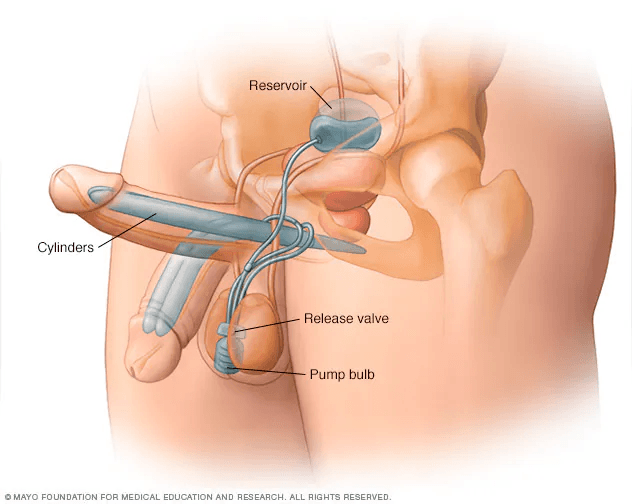
A penile prosthesis may be considered when erectile dysfunction and the curvature prevent sexual intercourse despite appropriate treatments. It is not the automatic treatment for all cases of Peyronie’s disease. [4]
What questions should you ask before making a decision?
- Is my curvature still progressing?
- What is a realistic goal in terms of pain, curvature and length?
- Which treatments are suitable for my situation, and what is the level of evidence supporting them?
- What risks are there to my erections and sensation?
- How will the results be assessed and how will I be monitored?
Frequently asked questions
Is Peyronie’s disease a form of cancer?
No. The fibrous plaque associated with this condition is benign. However, any new abnormality must be assessed to determine its cause. [1]
Does the disappearance of pain mean that the curvature has gone?
No. The pain may subside whilst the curvature remains. [1]
Does surgery always restore lost length?
No. Results regarding length vary, and some techniques may shorten the penis. Expectations must be clarified before the procedure. [3]
Is an implant always necessary?
No. It is an option in certain situations where curvature is combined with treatment-resistant erectile dysfunction. [4]
General information to help you prepare for your consultation. Medically reviewed by a TebbHelp partner urologist
References
[1] NIDDK — Penile Curvature (Peyronie’s Disease). https://www.niddk.nih.gov/health-information/urologic-diseases/penile-curvature-peyronies-disease.
[2] European Association of Urology — Penile Curvature, online guidelines. https://uroweb.org/guidelines/sexual-and-reproductive-health/chapter/penile-curvature
[3] EAU Patient Information — Surgery for penile curvature. https://patients.uroweb.org/condition/penile-curvature/treatment-options-penile-curvature/surgery-for-penile-curvature
[4] American Urological Association — Peyronie’s Disease Guideline, 2015. Historical reference to be read in conjunction with the EAU online guidelines. https://www.auanet.org/documents/Guidelines/PDF/clinical-guidance/Peyronies-Disease.pdf
Sources consulted on 19 October 2026.
Sources
- https://www.niddk.nih.gov/health-information/urologic-diseases/penile-curvature-peyronies-disease.
- https://uroweb.org/guidelines/sexual-and-reproductive-health/chapter/penile-curvature
- https://patients.uroweb.org/condition/penile-curvature/treatment-options-penile-curvature/surgery-for-penile-curvature
- https://www.auanet.org/documents/Guidelines/PDF/clinical-guidance/Peyronies-Disease.pdf