Penile prosthesis and Peyronie’s disease: what is the role of grafting?
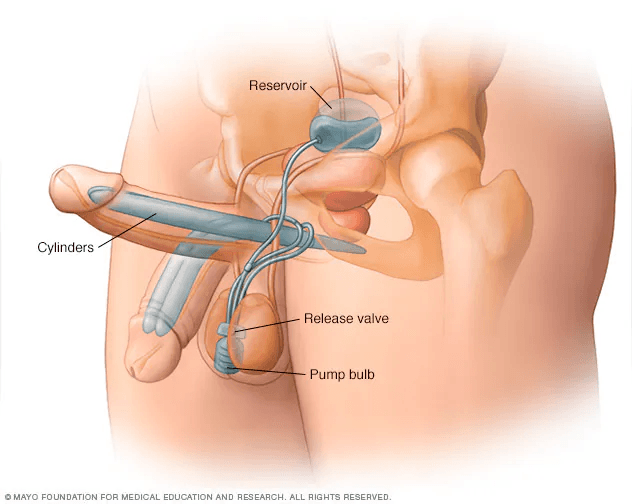
When Peyronie’s disease is accompanied by erectile dysfunction that does not respond to treatment, a penile prosthesis may be discussed. Curvature correction and, in some cases, a biological graft may be added. Grafting is not routinely required.

Author : TebbHelp editorial team
Published :
Updated :
Medical review pending
How can we reach you?
Required fields must be completed before you send the request.
When should a penile prosthesis be discussed?
Peyronie’s disease can involve both penile curvature and difficulty achieving a sufficiently firm erection. When appropriate treatments do not allow satisfactory intercourse, a penile prosthesis may be discussed. It is not the automatic treatment for every curvature. [4]
Assessment distinguishes two goals: achieving usable rigidity and correcting a troublesome deformity. Grafting alone and a prosthesis therefore do not address exactly the same problem. Erectile quality before surgery helps guide the choice. [3, 4]

Does a prosthesis always correct the curvature?
In some situations, inserting the cylinders provides sufficient correction. If a substantial deformity remains, the surgeon may add a straightening procedure: modelling in the operating theatre, plication or incision of the fibrous area, with or without a graft. The decision depends on the observed result and the plan discussed before surgery. Patients must not attempt these procedures themselves. [1]
What does a biological graft do?
An incision in the tunica albuginea, the covering of the erectile bodies, may leave an opening that needs covering. A graft then acts as a repair patch. Depending on the procedure, incision and grafting may be performed without a prosthesis or alongside its implantation. Grafting is not necessary in every operation for Peyronie’s disease. [1, 2]
The expression “organic tissue graft” needs clarification: “biological graft” is more precise. It may come from the patient (autograft), a human donor (allograft), or animal tissue prepared for medical use (xenograft). It is not a whole-organ transplant. [1]
Which tissue can be used, and how is it chosen?
Reported materials include certain venous or fascial tissues and biological matrices. An autograft may require tissue harvesting from another part of the body: the effects at the donor site and the additional operating time should be explained. [3]
No graft suits every situation. Selection depends on the deformity, the repair needed, the team’s experience, available evidence and the patient’s informed preferences. Ask about the exact origin of the proposed material, why it was chosen and the alternatives. [3]
When may grafting be considered?
Incision and grafting may be considered for certain complex or substantial deformities. In a man with preserved erections, this reconstructive surgery may be discussed without a prosthesis. If treatment-resistant erectile dysfunction is present, the role of a prosthesis should be assessed separately, together with any additional procedures. [3, 4]
Before straightening surgery, the team generally checks that the disease is stable and assesses functional difficulty. A recent deformity that is still changing does not automatically require immediate surgery. [2]
What limitations and risks should be understood?
Surgery guarantees neither a perfectly straight penis nor restoration of its length before the disease. Residual curvature, shortening, altered sensation or erectile difficulty may occur after correction. The consequences depend on the chosen procedure. [2]
Grafting does not guarantee preservation or recovery of length. Erectile quality after reconstruction without a prosthesis should also be discussed. Comparisons between materials remain limited and do not identify a universally superior graft. [3]
When a prosthesis is implanted, its own benefits and risks should be explained, along with recovery, learning to use it and the possibility of additional procedures. Expectations are an integral part of informed consent. [4]
What should you ask the surgeon?
- Why do you recommend a prosthesis in my case?
- Is an additional correction procedure likely to be needed?
- In what circumstances would you use a graft?
- Will it come from my body, a human donor or an animal source?
- What results are realistic for curvature, length and sensation?
- How will follow-up and resuming use of the device be organised?
Frequently asked questions
Is grafting always needed with a prosthesis and Peyronie’s disease?
No. Additional procedures depend particularly on the deformity and the correction achieved during implantation. [1]
Can grafting be performed without a prosthesis?
Yes. Some reconstructions are performed without a prosthesis when erectile function is suitable for this option. [4]
Does a biological graft guarantee increased length?
No. Grafting is not a promise of lengthening or regaining lost length. [3]
Can the entire plaque always be removed?
That is not a general rule. Techniques vary and must account for their effects on erectile function. [3]
General information to help prepare for a specialist consultation. This article does not replace an individual medical assessment.
References
[1] European Association of Urology — Penile Curvature. Online guidance: surgery, grafts and penile prostheses. https://uroweb.org/guidelines/sexual-and-reproductive-health/chapter/penile-curvature
[2] British Association of Urological Surgeons — Penile straightening by plication or plaque incision and grafting. Information on straightening procedures, not a universal implantation protocol. https://www.baus.org.uk/_userfiles/pages/files/Patients/Leaflets/Penile%20straightening.pdf
[3] Canadian Urological Association — Guideline for Peyronie’s disease and congenital penile curvature (2018). Historical supplementary reference, to be read with the online EAU guidance. https://www.cua.org/system/files/Guideline-Files/2018_cua_guideline_for_peyronie_rsquo_s_disease_and_congenital_penile_curvature5255.pdf
[4] American Urological Association — Peyronie’s Disease Guideline (2015). Supplementary reference on indications for the different procedures. https://www.auanet.org/documents/Guidelines/PDF/clinical-guidance/Peyronies-Disease.pdf
[5] NIDDK — Penile Curvature (Peyronie’s Disease). General patient information. https://www.niddk.nih.gov/health-information/urologic-diseases/penile-curvature-peyronies-disease.
Sources consulted in the French original on 19 October 2026.
Sources
- https://uroweb.org/guidelines/sexual-and-reproductive-health/chapter/penile-curvature
- https://www.baus.org.uk/_userfiles/pages/files/Patients/Leaflets/Penile%20straightening.pdf
- https://www.cua.org/system/files/Guideline-Files/2018_cua_guideline_for_peyronie_rsquo_s_disease_and_congenital_penile_curvature5255.pdf
- https://www.auanet.org/documents/Guidelines/PDF/clinical-guidance/Peyronies-Disease.pdf
- https://www.niddk.nih.gov/health-information/urologic-diseases/penile-curvature-peyronies-disease.