Penile implant: how to assess your dexterity before making a choice?
Being able to use your implant with confidence is part of the decision-making process. Hand strength, precision of movement, vision and learning: these are the points to discuss with your medical team to help you make a decision suited to your daily life, including in later life.
Author : Tarik El Rhazal
Published :
Updated :
French source medically reviewed — reviewer identity confidential
How can we reach you?
Required fields must be completed before you send the request.
Medical proofreading carried out on the French text.
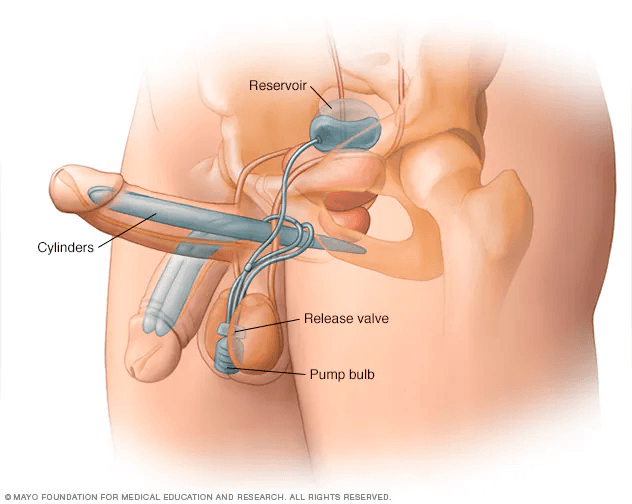
Regaining sufficient rigidity for sexual intercourse is one of the expected benefits of a penile implant. Being able to use the device with confidence is also part of the desired outcome. Before choosing an inflatable prosthesis, also known as a hydraulic prosthesis, it is therefore useful to assess your hand strength, the precision of your movements and your learning needs with the healthcare team. [1, 2]
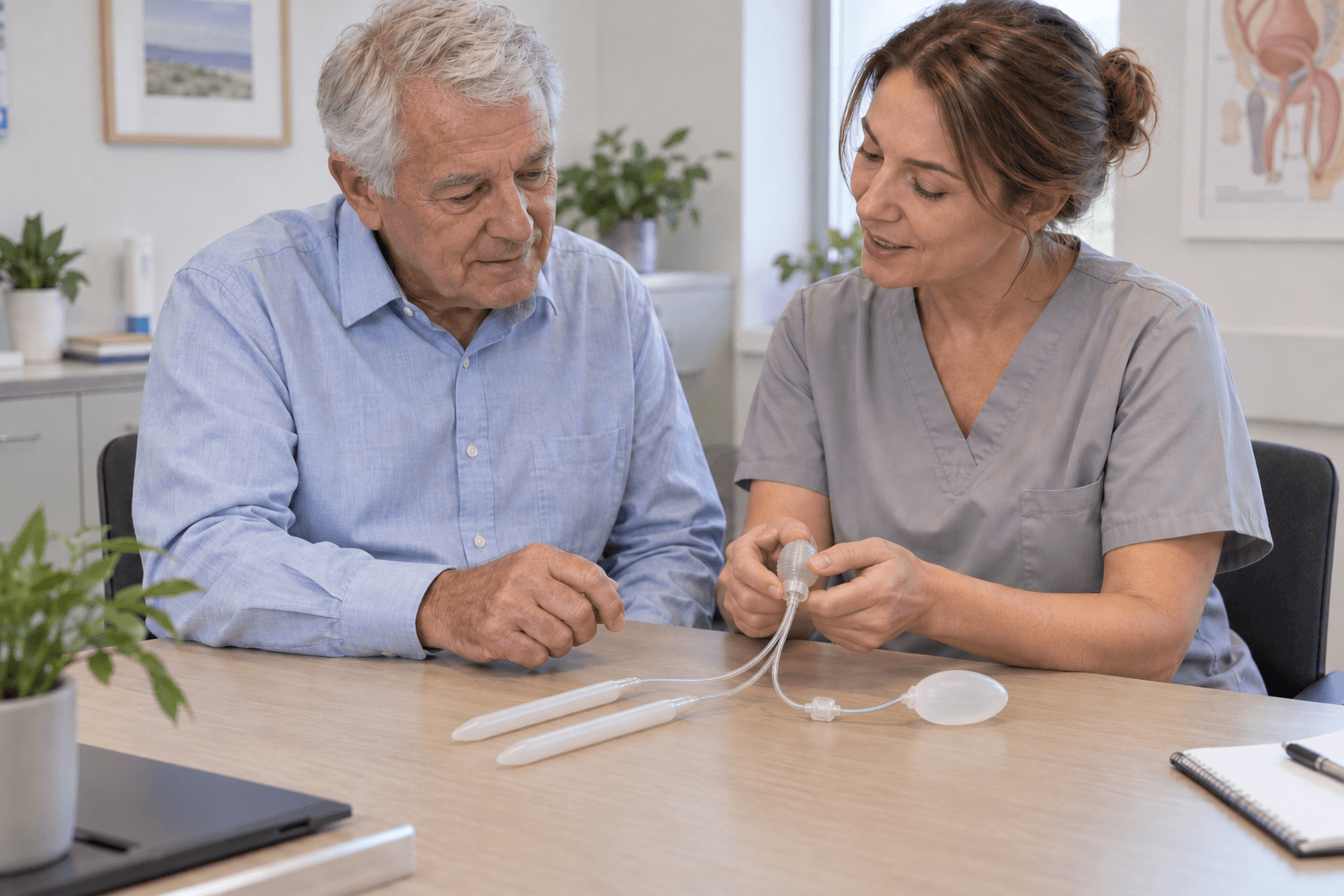
This discussion can open up possibilities, even in later life. It helps you make a choice suited to your daily life and the level of independence you wish to maintain.
Age alone does not define your capabilities
Drawing on his experience of coordinating patient care pathways, Tarik El Rhazal reports that men aged 76, 79 and over 80 have used their hydraulic prostheses without reporting any difficulties in handling them. These observations from clinical practice do not constitute a clinical study nor do they guarantee the same outcomes for other patients.
A study published in 2014 provides further insight: of 216 men who received their first inflatable implant, 30 were aged 75 or over. The researchers found no statistically significant difference in ease of use or satisfaction between the age groups. However, the study involved patients selected for the procedure and a small group of elderly men. [3]
Your general state of health, your actual movements and your ability to understand how the device works therefore warrant an individual assessment.
Discussing what causes you difficulties in daily life
Dexterity refers to the ability to perform precise movements. It involves more than just the strength of a handshake. Pain in the fingers, tremors, loss of sensation or limited use of an arm can make certain movements more difficult.
During your consultation, describe in practical terms what you can do easily and what causes you difficulty. In particular, mention any osteoarthritis, paralysis, after-effects of a stroke or neurological conditions. This information enables the team to assess the impact on manual dexterity, rather than making a decision based solely on the name of a diagnosis.
Understanding and retaining the explanations are also important. The official patient information leaflet for an inflatable prosthesis states that manual dexterity and certain cognitive difficulties may affect its use. It is not a matter of determining your own eligibility: this assessment is the responsibility of the healthcare professional examining you. [2]
What a grip strength test can reveal
A study published in 2025 assessed 29 patients prior to the fitting of an inflatable implant. Greater grip strength – that is, the ability to squeeze with the hand – was associated with fewer reported difficulties in using the device after the procedure. Other assessments, including pinch strength and a finger dexterity test, showed no statistically significant association. [4]
This finding suggests that a strength measurement may complement the consultation when manual abilities are uncertain. It does not define a universal figure for selecting an implant, nor does it guarantee an individual outcome. Nor does this small study allow us to predict the long-term outcome for a person with neurological sequelae.
Try a model before making a decision
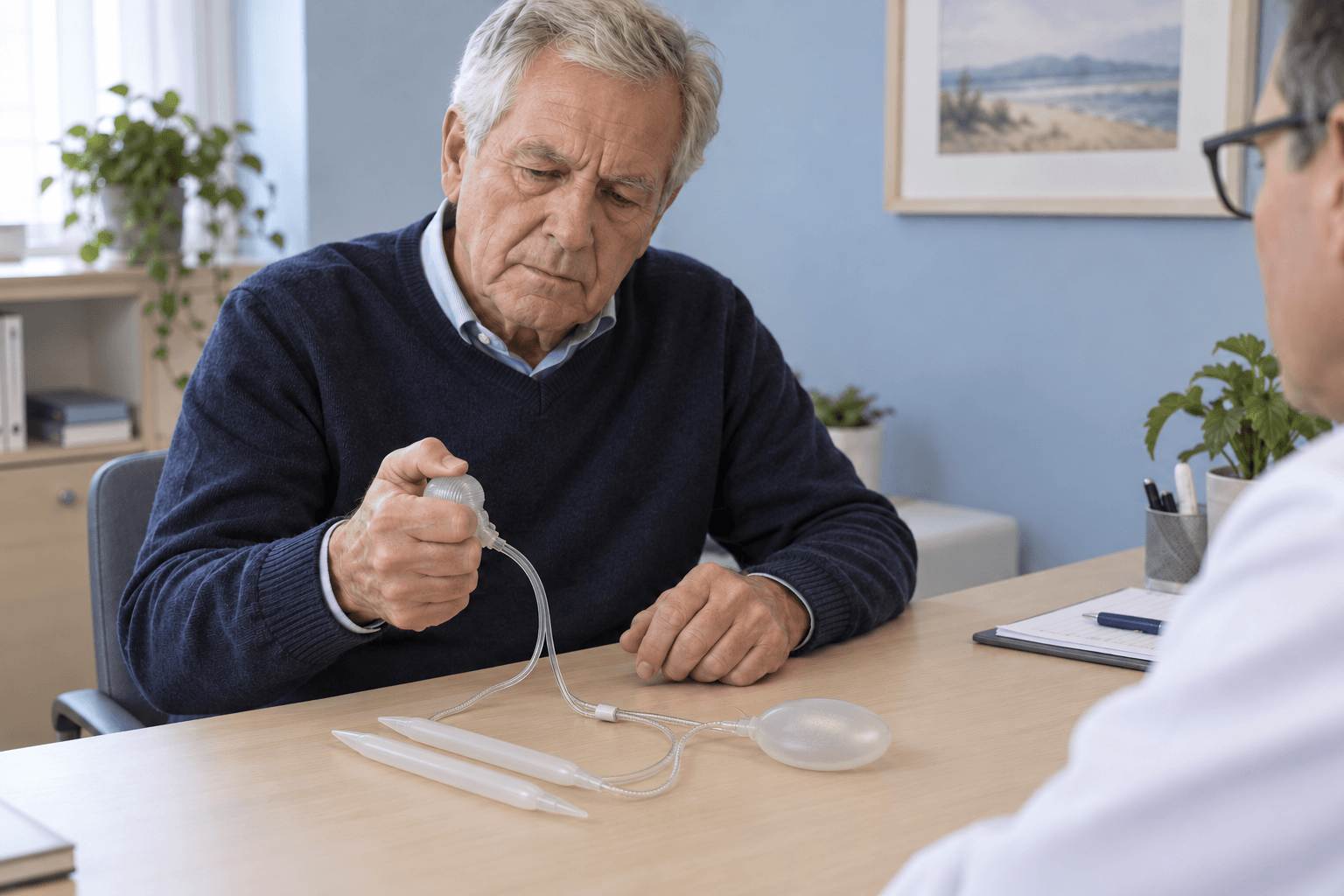
A demonstration helps to make the discussion more concrete. Ask if you can explore and handle an educational model corresponding to the device under consideration, with a trained professional present. You will be able to explain what you find easy, difficult or tiring, and ask your questions at your own pace.
Assessment using a model is notably featured in a study of 114 patients: pre-operative selection took into account the ability of the patient or their partner to use a demonstration device. This describes a clinical practice worth discussing, without treating it as a test that can reliably predict use following implantation. [5]
Tailoring the learning process to your needs
Any initial difficulties are worth discussing with the team. Tailored support can help some people make progress. However, it does not necessarily compensate for a significant motor impairment or a comprehension disorder.
Tarik also reports the case of a visually impaired person for whom familiarising themselves with the model was initially difficult, but became easier with practice. This is an individual experience.
If you have poor eyesight or find written materials unsuitable, ask for verbal explanations, guidance on locating tactile reference points on the model, and the option to have the demonstration repeated. The team will be able to check with you what you have understood and what is achievable. A video alone does not meet everyone’s needs.
What role for your partner
If you both wish, your partner can be involved in the demonstration and the learning process. Assistance with handling the device may be considered with your consent, following an assessment and explanations from the team. This involvement is also described in Tarik’s experience of coordination. [5]
Please specify what you would like to be able to do on your own, the level of assistance you would accept, and what would be possible when your partner is unavailable. This discussion respects your privacy and avoids the assumption that assistance will always be available.
When to discuss a malleable prosthesis
A malleable, or semi-rigid, prosthesis does not use a pump. It may be an option where manual dexterity is limited, as indicated in the European guidelines. However, it requires manual positioning and remains permanently rigid, with considerations regarding discretion and comfort to be discussed. [1]
Although it is simple to operate, this does not eliminate the risks associated with implantation. The choice takes into account your abilities, your preferences, your anatomy and the medical assessment.
Preparing for your next consultation
Before making a decision, ask: - Can I try out the proposed model with the team? - What difficulties would need to be assessed in my case? - What tailored training can be offered? - If assistance is required, how can this be organised with my consent? - What alternatives are suitable for my abilities and expectations?
TebbHelp can help you prepare these questions and organise your discussions with the medical team. The decision and explanations regarding the use of your device remain personalised.
General information. This article is not a substitute for a consultation or the advice given by your healthcare team.
Further reading
When to discuss a penile prosthesis
Preparing for recovery and follow-up care after discharge
Preparing your questions with TebbHelp
Sources
1. European Association of Urology. EAU Guidelines on Sexual and Reproductive Health, 2026 edition, section 5.6.11.c, Penile prostheses. https://uroweb.org/guidelines/sexual-and-reproductive-health/chapter/management-of-erectile-dysfunction
2. Boston Scientific. AMS 700 Inflatable Penile Prosthesis with TENACIO Pump, US official leaflet, reference 51558342-01A. Patient precautions, p. 8, and patient information, p. 42. https://www.bostonscientific.com/content/dam/elabeling/uro-ph/ams700-tenacio-pump/51558342-01A_AMS700_TENACIOPump_IFU_US_EN_s.pdf
3. Chung E, Solomon M, DeYoung L, Brock GB. Clinical outcomes and patient satisfaction rates among elderly men aged ≥75 years with an inflatable penile prosthesis implant for medically refractory erectile dysfunction. World Journal of Urology. 2014;32(1):173–177. DOI: 10.1007/s00345-013-1102-7. https://pubmed.ncbi.nlm.nih.gov/23708698/
4. Campbell K et al. Manual Dexterity Predictors of Inflatable Penile Prosthesis Success. Urology. 2025;199:155–161. DOI: 10.1016/j.urology.2025.01.074. https://pubmed.ncbi.nlm.nih.gov/39924118/
5. Knoll P et al. A Survey of Usage of Penile Prostheses. Journal of Sexual Medicine. 2020;17(11):2287–2290. DOI: 10.1016/j.jsxm.2020.07.082. https://pubmed.ncbi.nlm.nih.gov/32883632/
The observations on coordination reported by Tarik El Rhazal are distinct from the studies cited and do not constitute published clinical data.
Sources
- https://uroweb.org/guidelines/sexual-and-reproductive-health/chapter/management-of-erectile-dysfunction
- https://www.bostonscientific.com/content/dam/elabeling/uro-ph/ams700-tenacio-pump/51558342-01A_AMS700_TENACIOPump_IFU_US_EN_s.pdf
- https://pubmed.ncbi.nlm.nih.gov/23708698/
- https://pubmed.ncbi.nlm.nih.gov/39924118/
- https://pubmed.ncbi.nlm.nih.gov/32883632/