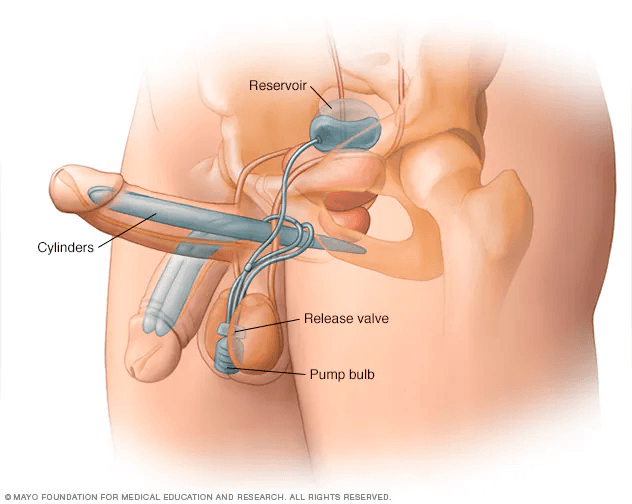
Penile implant: desire, sensations, orgasm and ejaculation
Regaining reliable erectile function can restore a sense of normality to sexual relations. Studies shed light on satisfaction following implantation and expectations regarding pleasure.
Author : TebbHelp Editorial Team
Published :
Updated :
Medical review pending
How can we reach you?
Required fields must be completed before you send the request.
Medical review pending.
Regaining sufficient rigidity for sexual intercourse, being able to rely on one’s erection and looking forward to a more satisfying sex life: these are the benefits sought with a penile implant. When erectile dysfunction persists despite treatment, this solution can mark a new chapter in one’s sex life. Sensations, orgasm and ejaculation are usually preserved if they were present before the procedure. [1, 2]

What do the studies show regarding satisfaction?
The published results are encouraging. In a 2019 Belgian study involving 126 patients who had undergone surgery, 95 responded to the survey: 79 were satisfied with their implant – 83.2 per cent – at least one year after the procedure. [3]
A French study published in 2026 also reports high levels of satisfaction. Of the 201 patients included, 89 completed the SSIPI questionnaire: 88.7 per cent of these respondents were satisfied, with 58.4 per cent reporting they were very satisfied. [4]
Both these studies relate to inflatable prostheses and describe the responses of the patients surveyed, not a guaranteed outcome for every individual. Nevertheless, they show that a satisfying sex life following implantation is a realistic prospect. The quality of information, personal expectations and follow-up care all play a part in this experience. [8]
An erection you can rely on
The prosthesis provides mechanical support to the penis to achieve and maintain the rigidity required for penetration. With an inflatable model, the patient controls this rigidity using a pump located in the scrotum. This reduces dependence on a spontaneous erectile response, which can sometimes become unpredictable. [1, 2]
The benefits may extend beyond penetration alone: regaining the ability to have sexual intercourse is one of the couple’s objectives. Each person’s desires, comfort and preferences therefore deserve to be discussed during the consultation. If you wish, your partner can take part in this discussion. [2, 8] To understand how the device works, see our guide to hydraulic penile prostheses.
Are sensations still present?
Usually, yes. The implant affects rigidity, whilst sensitivity in the skin of the penis generally remains intact. However, the experience may feel different and require some adjustment. The glans may also remain less firm than the shaft of the penis. [1, 2]
A prospective study published in 2017 provides an interesting benchmark: 62 men took part, out of 86 eligible for a first inflatable implant. Measurements taken before the operation, at six weeks and at six months showed no statistically significant change in the glans’ sensitivity to vibrations. This test assesses precise sensory perception, not the intensity of pleasure. [5]
Is it still possible to have an orgasm?
Yes, the ability to reach orgasm is generally preserved if it existed previously. An orgasm is the culmination of pleasure; it does not depend solely on the firmness of the penis. Regaining functional rigidity can therefore enable a return to sexual intercourse and the pleasure it brings. [1]
In the Belgian study, 87 out of 95 respondents reported having reached orgasm after the procedure. This result shows that orgasm remains possible with a prosthesis; it does not measure a ‘before-and-after’ preservation rate. Any pre-existing difficulty in achieving orgasm should be discussed with the urologist. [3]
What about ejaculation?
It usually remains possible if it was possible before the implant was fitted. The implant supports an erection but is not designed to restore ejaculation that has already been impaired by a medical condition or treatment. [1]
Following a radical prostatectomy, for example, the prostate and seminal vesicles have been removed: orgasm may still be possible, but without the emission of semen. The implant can help restore the rigidity necessary for sexual intercourse, without restoring ejaculation. This ‘dry orgasm’ illustrates why pleasure and ejaculation must be distinguished. [7]
Desire and testosterone
Sexual desire may well be present despite difficulty achieving an erection. In such cases, the implant addresses the mechanical barrier. It does not directly increase libido: a reduction in sexual desire warrants an assessment that also takes into account health, medication and the relationship context. [2, 8]
Testosterone is not routinely prescribed alongside the implant. Treatment may help some men experiencing symptoms and a hormonal deficiency confirmed by repeated blood tests, usually taken in the morning on an empty stomach. Age alone is not sufficient for diagnosis. Gels such as Testogel are prescription-only medicines that must be used under medical supervision, with particular precautions regarding fertility and skin transfer to those around you. They must not be applied to the genitals. [9, 10]
Ensuring the outcome meets your expectations
The procedure is a long-term and irreversible choice. Its risks include, in particular, infection, persistent pain, changes in sensation or perceived length, and device failure, which may require further surgery. How significant these risks are depends on your individual circumstances and the long-term outlook. Ask the surgeon about their results and the planned follow-up care. [2, 3, 6, 8]
Before your appointment, make a note of your priorities: resuming sexual activity, preserving sensation, coming to terms with a different kind of orgasm, or addressing a decline in sexual desire. Specify what works for you at present and what is causing you concern. This information will help you discuss the expected benefits, other options and the limitations specific to your case.
Follow-up care is part of the process. Resuming sexual activity must be authorised by your surgeon, depending on how well you have healed. [1] Our article on recovery and follow-up after resuming sexual activity will help you prepare for this stage.
Are you considering a penile implant? Contact TebbHelp to discuss your plans with a coordinator and prepare your questions. The urologist will then assess your suitability, the expected benefits and any personal risks. This general information is intended to complement, not replace, this consultation.
Sources
1. Cleveland Clinic, patient information on penile implants. 2. Mayo Clinic, benefits and limitations of penile implants. 3. Jorissen et al., satisfaction following implantation, 2019. 4. Neuranter et al., long-term satisfaction, 2026. 5. Xie et al., prospective study of sensitivity, 2017. 6. Akdag et al., self-reported sensitivity and satisfaction, 2026. 7. American Cancer Society, sexuality after prostatectomy. 8. EAU, guidelines on erectile dysfunction. 9. EAU, guidelines on male hypogonadism. 10. Testogel, official summary of product characteristics.
Sources
- https://my.clevelandclinic.org/health/treatments/10054-surgical-penile-implants
- https://www.mayoclinic.org/tests-procedures/penile-implants/about/pac-20384916
- https://pmc.ncbi.nlm.nih.gov/articles/PMC6872984/
- https://www.em-consulte.com/article/1825880/long-term-satisfaction-and-outcomes-after-inflatab
- https://tau.amegroups.org/article/view/15268/html
- https://pubmed.ncbi.nlm.nih.gov/41999394/
- https://www.cancer.org/cancer/types/prostate-cancer/treating/surgery.html
- https://uroweb.org/guidelines/sexual-and-reproductive-health/chapter/management-of-erectile-dysfunction
- https://uroweb.org/guidelines/sexual-and-reproductive-health/chapter/male-hypogonadism
- https://www.medicines.org.uk/emc/product/8919/smpc