Penile implants and heart disease: what assessment is needed before deciding?
Heart disease does not automatically rule out a penile implant. The procedure, medications and return to sexual activity need to be assessed with the urologist and medical team.

Author : TebbHelp Editorial Team
Published :
Updated :
Medical review pending
How can we reach you?
Required fields must be completed before you send the request.
Can a penile implant be considered if you have heart disease?
A penile prosthesis may be discussed for some men with erectile dysfunction and cardiovascular disease. The decision depends on the urological need, the stability of the heart condition, the surgical risk and the patient's expectations. A cardiac diagnosis alone is therefore not enough to accept or rule out the procedure. [1, 2, 3]
Two questions need to be distinguished: can you undergo surgery under suitable conditions, and when can you resume sexual activity? A prosthesis provides mechanical rigidity; it does not treat heart disease. [1, 2]

Why assess the heart in someone with erectile dysfunction?
Erectile dysfunction can be associated with cardiovascular risk factors and may sometimes precede the recognition of vascular disease. It warrants a medical discussion, even when the original reason for seeking advice concerns sexual health. This does not mean that every erection problem indicates heart disease. [2]
To assess the safety of sexual activity, the team considers symptoms, known conditions, exercise tolerance and medications, among other factors. Severe or unstable disease must be stabilised before sexual activity resumes. A simple self-test, such as climbing stairs, does not replace this medical advice. [2]
What assessment should you prepare for before penile implant surgery?
Assessment before non-cardiac surgery should be tailored to the individual and the operation. It does not mean routinely requesting every available test. The urologist and anaesthetist, together with a cardiologist when needed, arrange the appropriate investigations and medication management. [3]
Prepare the following for your consultations:
- A complete list of your medications, including those taken occasionally.
- Reports of any heart attack, coronary stent placement, heart surgery or hospital admission.
- Information about any heart valve, pacemaker or defibrillator.
- Your current symptoms and any recent changes in your exercise capacity.
- Test results and the contact details of your usual medical team.
This practical list helps you prepare for the discussion; it does not replace the assessment prescribed for you.
Coronary stents, anticoagulants and antiplatelets: what precautions are needed?
A coronary stent, particularly a recently placed one, may affect the timing of planned surgery. The team needs to know when and why it was inserted, as well as the associated treatments. [3]
Anticoagulants and antiplatelet medicines have different indications. Their management must take both bleeding and thrombosis risks into account. Stopping a medicine may expose you to a cardiovascular event; continuing it may also affect surgical risk. Do not change or stop your treatment without instructions from the team. Ask for a written plan explaining what to take, what to adjust and when to restart treatments. [3]
Nitrates: why should you tell your urologist about them?
Nitrates, used particularly for angina, must not be combined with PDE5 inhibitors such as sildenafil or tadalafil because of the risk of a dangerous fall in blood pressure. Also mention medicines taken only when you have pain. Do not stop heart medication in order to take a medicine for erectile dysfunction. [6]
If a drug treatment is contraindicated or insufficient, other approaches can be discussed. This does not automatically make an implant necessary: the choice remains individual. [1]
When does a penile implant become an option?
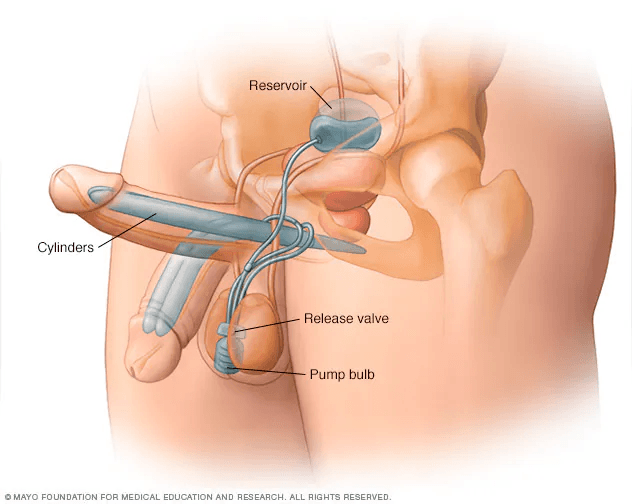
An implant may be offered when other treatments are unsuitable or have failed, or according to the patient's preferences after receiving full information. The choice between an inflatable and a semi-rigid model should take into account operating the device and expectations. [1]
Before deciding, discuss the benefits, practical demands and possible complications, including infection, mechanical problems or the need for another operation. A systemic, skin or urinary tract infection is a contraindication to prosthetic surgery until it has been addressed. [4]
How should recovery and the return to sexual activity be organised?
Follow-up checks wound healing and explains how to use the device. The timing of resuming sexual activity must follow the surgical team's instructions and the cardiac assessment. For example, the UCLH information sheet on a semi-rigid implant specifies six weeks without intercourse; this is not individual clearance and does not automatically apply to every care pathway. [2, 5]
After surgery, contact the team promptly if you develop fever, redness or wound discharge, persistent bleeding or uncontrolled pain. If you are having surgery far from home, arrange the department's contact details and follow-up after your return before you travel. [5]
Frequently asked questions
Does heart disease always rule out a penile implant?
No. The decision rests on an individual assessment of the indication, surgical risk and cardiovascular stability. [1, 2, 3]
Can I stop my anticoagulant before the operation?
Do not decide this on your own. The team must provide instructions suited to your medication and the reason it was prescribed. [3]
Does an implant mean I can ignore cardiac precautions during intercourse?
No. It provides mechanical rigidity without removing the cardiovascular demands of sexual activity. [1, 2]
What should I discuss with the urologist?
Ask why an implant is being proposed, what alternatives remain possible, how your medicines will be managed and who will coordinate follow-up with your cardiologist.
General information to help prepare for a consultation. Editorial draft requiring medical review before publication.
References
[1] European Association of Urology — Management of Erectile Dysfunction, online guidelines. https://uroweb.org/guidelines/sexual-and-reproductive-health/chapter/management-of-erectile-dysfunction
[2] American College of Cardiology — Highlights From the Princeton IV Consensus Guidelines, 23 September 2024. https://www.acc.org/Latest-in-Cardiology/Articles/2024/09/23/10/45/Erectile-Disfunction-as-an-ASCVD-Risk-Enhancing-Factor
[3] AHA/ACC and partner societies — Guideline for Perioperative Cardiovascular Management for Noncardiac Surgery, 2024. https://www.jacc.org/doi/10.1016/j.jacc.2024.06.013
[4] American Urological Association — Erectile Dysfunction: AUA Guideline, 2018. Reference on preoperative counselling and infection-related contraindications; to be read alongside the online European guidelines. https://www.auanet.org/documents/Guidelines/PDF/ED-JU.pdf
[5] University College London Hospitals — Insertion of a malleable penile prosthesis, updated 31 January 2025. These instructions specifically concern a semi-rigid implant. https://www.uclh.nhs.uk/patients-and-visitors/patient-information-pages/insertion-malleable-penile-prosthesis
[6] American College of Cardiology — Erectile Dysfunction Medications May Increase Risk of Death When Combined with Common Chest Pain Medication, 15 January 2024. Information on the contraindicated combination of nitrates and PDE5 inhibitors. https://www.acc.org/about-acc/press-releases/2024/01/12/21/58/erectile-dysfunction-medications-may-increase-risk-of-death-when-combined-with-common-chest-pain-medication
Sources accessed on 19 October 2026.
Sources
- https://uroweb.org/guidelines/sexual-and-reproductive-health/chapter/management-of-erectile-dysfunction
- https://www.acc.org/Latest-in-Cardiology/Articles/2024/09/23/10/45/Erectile-Disfunction-as-an-ASCVD-Risk-Enhancing-Factor
- https://www.jacc.org/doi/10.1016/j.jacc.2024.06.013
- https://www.auanet.org/documents/Guidelines/PDF/ED-JU.pdf
- https://www.uclh.nhs.uk/patients-and-visitors/patient-information-pages/insertion-malleable-penile-prosthesis
- https://www.acc.org/about-acc/press-releases/2024/01/12/21/58/erectile-dysfunction-medications-may-increase-risk-of-death-when-combined-with-common-chest-pain-medication